What Resolution Does a Home Security Camera Need?
For most homes, 2K or 4K resolution is a useful starting point: choose 4K when you need more detail across a wide view or at a distance, and 2K when storage and bandwidth matter more. Resolution alone can't guarantee a clear face or readable plate.
On this page (8 sections)
- What resolution should a home security camera have?
- Does 4K always mean clearer security footage?
- How much resolution do you need to identify people or vehicles?
- How do camera resolution and storage work together?
- What is the difference between 2K, 3K, 4K, and 8MP?
- Does higher resolution use more bandwidth?
- How should you choose resolution for each camera location?
- How do you compare the best resolution home security camera options?
For most homes, 2K or 4K is a practical resolution range: pick 4K when you need finer detail across a wide scene or farther away, and 2K when storage and bandwidth matter more. The best resolution home security camera is the one that captures the detail you need at the distance and lighting conditions you have.
More pixels can help reveal detail, but they don't guarantee a recognizable face or readable license plate. Camera placement, lens view, lighting, motion, compression, and recorder settings all matter.
What resolution should a home security camera have?
Choose 4K for wide or distant views, and consider 2K for closer everyday coverage. A lower resolution can still work for a narrow entryway if the camera is aimed well and the subject passes close by.
Resolution describes how many pixels make up an image. A 4K camera records more pixels than a 2K camera, which can preserve more detail when you zoom in, but it also creates larger video files.
For a porch or side door, aim the camera so a person appears large in the frame. For a broad driveway or yard, higher resolution may preserve useful detail farther across the image, though a wide lens can still make distant subjects look small.
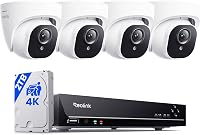
The Reolink RLK8-800B6 is a wired PoE system with a recorder and a 2TB hard drive for continuous recording. Reolink says the system works exclusively with Reolink PoE cameras, so check compatibility before planning a mixed-camera setup.
Does 4K always mean clearer security footage?
No, 4K doesn't guarantee clearer footage in every scene. A camera with more pixels can still produce poor evidence if the subject is far away, moving quickly, backlit, or outside the camera's focus.
A camera's field of view spreads its pixels across the scene. If you point one camera at a large yard, a person near the far edge may occupy only a few pixels even at 4K.
Night conditions also matter. Infrared illumination, visible light, exposure, and motion handling affect how much detail remains after dark.
Review night footage rather than relying on the resolution label alone.
Camera angle can make a difference too. A camera mounted too high may show the top of someone's head instead of their face, while glare from a window or porch light can wash out details.
How much resolution do you need to identify people or vehicles?
For identification, camera position and subject size often matter as much as resolution. Set the camera close enough and at an angle that captures useful detail, then check the recorded image rather than only the live view.
For a front door, point the camera toward the approach path instead of covering the entire front yard. For a driveway, decide whether you care most about a vehicle entering, a person's face, or general activity, because one camera angle may not do all three well.
Don't assume a 4K camera will read a plate from any distance. Plate size in the frame, headlight glare, vehicle speed, and the camera's exposure can limit legibility.
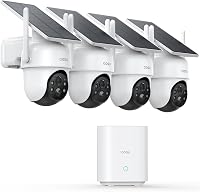
The Hiseeu kit includes 4K cameras with pan and tilt and automatic human tracking. Its cameras need power even though the system uses WiFi for the camera connection.
Consider this kind of setup when a broad area needs flexible viewing. A moving camera can shift away from a fixed entry route, so it may not replace a separate camera aimed at a doorway or driveway entrance.
How do camera resolution and storage work together?
Higher resolution can shorten the time your recorder keeps footage if other settings stay the same. Storage duration also depends on compression, frame rate, number of cameras, and whether recording runs continuously or only after motion.
A system that records 24/7 writes video all day, including quiet periods. Motion-triggered recording may use less storage, but it can miss the start of an event if detection or recording settings aren't suited to the scene.
The ANNKE system includes four 2MP cameras, while its 8-channel DVR supports 1080P cameras and compatible 3K or 5MP cameras. The included cameras capture 1080P footage, so the DVR's support for higher-resolution cameras doesn't change their resolution.
Check your retention goal before selecting camera resolution. Our guide to how long security camera footage lasts explains how recording habits and storage capacity affect retention.
What is the difference between 2K, 3K, 4K, and 8MP?
The labels describe image size, but compare the actual pixel dimensions when they are available. “4K” commonly refers to 3840 x 2160, which is about 8 million pixels, or 8MP.
“2K” and “3K” can be used loosely across camera products, so don't treat the label as a universal guarantee of exact pixel dimensions. Check the stated resolution for both the camera and recorder, and confirm they match.
A higher maximum resolution supported by a recorder doesn't upgrade a lower-resolution camera. The recorded image is limited by the camera's sensor and the recorder's supported settings.
Resolution may also change by mode. A camera can have one maximum resolution for live view and another for recording, so check both when the distinction affects your needs.
What does the highest resolution security camera label tell you?
It tells you the camera's maximum pixel count, not how much usable detail you'll see in every clip. A high-resolution camera may help with cropping or broad scenes, but the lens, lighting, bitrate, and distance still shape the result.
Use the maximum resolution as one part of the choice. Confirm that the recorder can accept it and that your storage can retain footage for the period you want.
Does higher resolution use more bandwidth?
Often, yes: higher-resolution video can require more network capacity, especially for live viewing or remote playback. Compression and frame rate affect bandwidth too, so check the full camera and recorder settings.
For a wired PoE system, the camera-to-recorder link uses Ethernet. The Reolink system can record locally without internet, while internet is needed for remote access.
A WiFi system still needs a reliable connection between camera and recorder or network. Hiseeu's 4K kit supports 2.4GHz and 5GHz WiFi, and its cameras require separate power.
Choose resolution with your network and storage limits in mind. For a broader look at recorder choices, see how to pick a home security camera system.
How should you choose resolution for each camera location?
Match resolution to the distance and task at each location instead of choosing the same setting everywhere. A close door view may need less resolution than a wide driveway view.
- Door or narrow entry: Prioritize a close, face-level angle and enough light; 2K may be adequate.
- Driveway: Consider 4K if the camera must cover a broad area or preserve more detail farther away.
- Backyard: Decide whether you need general activity coverage or detail at a gate or shed, then aim the camera accordingly.
- Indoor room: A modest resolution may be enough for a small, well-lit room, depending on how much detail you need.
These are starting points, not guarantees. Walk the likely approach path and review recorded clips from daytime and nighttime before relying on the camera for a specific detail.
How do you compare the best resolution home security camera options?
Compare camera resolution, recorder support, storage, and connection type as one system. A 4K camera doesn't help if the recorder can't store its video or the view is too wide to show the subject clearly.
Choose the Reolink kit if you want a wired PoE setup with 4K cameras and a 2TB drive. Choose Hiseeu if you want 4K cameras with pan and tilt and WiFi connectivity, while remembering that the cameras need power.
Consider ANNKE if its included 1080P cameras meet your needs and you want a DVR that can support compatible higher-resolution cameras later. Before expanding any system, check camera compatibility and recorder limits.
For storage decisions, compare hard drives for a security camera recorder and read about cloud versus local video storage. If night scenes matter most, our guide to night vision security camera systems covers another part of image quality.
The best resolution home security camera is the one that captures the needed detail without exceeding your recorder, network, or storage limits. Pick 4K for broader or more distant views, and choose a lower resolution when a close, well-aimed camera already covers the scene.
Frequently asked questions
Is 4K worth it for a home security camera?
4K can help when you need more detail across a broad view or at a distance, but it uses more storage and network capacity than lower resolutions. Check the camera's recording resolution, frame rate, and night image quality, then make sure your recorder and storage plan can support the footage.
Is 2K enough for a security camera?
2K can be enough for general entry, driveway, or yard monitoring when the camera is positioned close enough and aimed well. A larger pixel count won't fix glare, poor focus, motion blur, or a subject that's too far away, so match resolution to the scene and recording setup.
What resolution is best for identifying a face?
There isn't one resolution that guarantees face identification. Distance, lens view, camera angle, lighting, motion, and compression all affect detail.
Place the camera where a person's face fills more of the image and check the recorded view at the time of day you need it.
Does higher resolution use more storage?
Usually, higher-resolution footage needs more storage, though compression, frame rate, motion activity, and recording settings also affect file size. Check how long your system keeps recordings and whether you can expand its drive before choosing 4K cameras for every location.